Minggu, 27 Maret 2016

How To Article (Time To Talk)

Welcome back to my blog,this is my 3rd post. Here I want to make a summarize of my latest post titled Time To Talk using technique by my Lecturer Ratu Sarah. In making the summarize you have to understand the article or text you read, then you have to know what the title of the text you read, how many pages, what is the topic of the text,the detail (explanation), the purpose of the writer, quotation, and your opinion about the text you read. Ok this is the scope of my latest post.

Using “Talk Partner” strategy is an easy and practical way to build children’s confidence and encourage them to talk in English. This strategy gives children more thinking time and allows them to try out language and test ideas in a familiar and safe environment. As a result, they are more willing to take risks with their language, answer more open-ended questions and produce more extended responses. This strategy is needs to be carefully planned,  include setting up the strategy, developing the children’s communication skills and carefully selecting and building up Talk Partner tasks.

Setting Up Talk Partners
Here, u have to explain and demonstrate what young learners have to do. You can use matching cards, pull children’s names out of a bag or use one of the many random group generator apps that are available on phones and computers.

Developing communication skills
Communication is a two-way process and learners need to learn how to actively listen to their partner and talk meaningfully about the task. It’s a good idea, therefore, to establish some ground rules for being a good Talk Partner.


Building up Talk Partner tasks
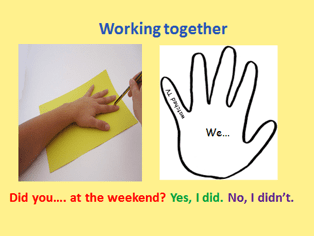
A good way to start is to use Talk Partners to practise short question and answer exchanges in pairs, for example Do you like …? Have you got …? What’s your favourite….?Once the children are confident doing this, you can ask them to find out and record similarities. For example, in the following activity, children need to find out and record five things they both did at the weekend. Talk is supported through language prompts and children record the five activities on their hand print.
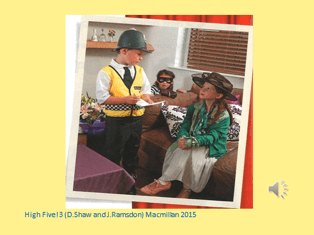
Open ended questions can be used with more competent language learners and the cooperative learning strategy think-pair-share provides children with the extra thinking time they need to answer these questions. In this strategy, the children think independently about the question before discussing their ideas with their Talk Partner. Then the pairs share their ideas with the whole group. Possible tasks include asking learners to discuss what they know about a topic, make a prediction or give and justify an opinion. In the following pre-listening task, the learners look at a photo of children acting out a play and discuss the questions: Who are the characters? What do you think the characters are talking about? After sharing their ideas with a partner and then the whole class, they listen to the first act of a short EFL play to find out.

Purpose of the writer ; To develop speaking skill of young learners using “Talk Partner” technique/strategy.

Quotation ; Talk Partners tasks are also enjoyable and help develop a more caring and cooperative classroom environment where everyone has a voice. So, what are you waiting for? It’s time to talk!


Opinion ; This article is very usefull to us to help young learners in developing their communication skills using “Talk Partner” strategy.

Minggu, 13 Maret 2016

TIME TO TALK

How much talking do your young learners do in class? We know that children love talking in their mother tongue – in fact it can be difficult to get them to stop at times – but getting children to talk in English is a challenge in many EFL classrooms.

Some children are reluctant to talk in English due to shyness, especially when speaking in front of the whole class. Other children may lack confidence in their ideas or in their ability to use English to express themselves.

Using the strategy of Talk Partners, where each child works with a set partner to rehearse language and to share ideas, is an easy and practical way to build children’s confidence and encourage them to talk in English. This strategy gives children more thinking time and allows them to try out language and test ideas in a familiar and safe environment. As a result, they are more willing to take risks with their language, answer more open-ended questions and produce more extended responses. However, the successful use of this strategy doesn’t just happen, it needs to be carefully planned. Key things to focus on include setting up the strategy, developing the children’s communication skills and carefully selecting and building up Talk Partner tasks.

Setting up Talk Partners


Talk Partners can be set up at any point of the course. There are different ways of doing this, but random pairs are generally considered to be fairer by children. You can use matching cards, pull children’s names out of a bag or use one of the many random group generator apps that are available on phones and computers. It is important to take time to explain the Talk Partners strategy to the class and to demonstrate how to turn and talk with a partner before you start.

Developing communication skills


For the strategy of Talk Partners to work effectively we need to help children develop their communication skills. Communication is a two-way process and learners need to learn how to actively listen to their partner and talk meaningfully about the task. It’s a good idea, therefore, to establish some ground rules for being a good Talk Partner. These can be displayed on a classroom poster and referred to before starting a new Talk Partner task. A list of rules might look like this:

timetotalk3


We can also provide support for talk by orally modeling the language the children need to complete the Talk partner task or by providing written language prompts and frames for speaking. These can be displayed on the board or the classroom wall and gradually reduced as the children gain communicative competence.

Building up Talk Partner tasks


There are many opportunities for using the Talk Partners strategy in a lesson, but it’s important to build up the children’s skills in small steps. A good way to start is to use Talk Partners to practise short question and answer exchanges in pairs, for example Do you like …? Have you got …? What’s your favourite….? Once the children are confident doing this, you can ask them to find out and record similarities. For example, in the following activity, children need to find out and record five things they both did at the weekend. Talk is supported through language prompts and children record the five activities on their hand print.
timetotalk1

Open ended questions can be used with more competent language learners and the cooperative learning strategy think-pair-share provides children with the extra thinking time they need to answer these questions. In this strategy, the children think independently about the question before discussing their ideas with their Talk Partner. Then the pairs share their ideas with the whole group. Possible tasks include asking learners to discuss what they know about a topic, make a prediction or give and justify an opinion. In the following pre-listening task, the learners look at a photo of children acting out a play and discuss the questions: Who are the characters? What do you think the characters are talking about? After sharing their ideas with a partner and then the whole class, they listen to the first act of a short EFL play to find out.
timetotalk2

There are many reasons for using the Talk Partners strategy in your classroom. It can be used successfully in big or small classes and provides opportunities for you to observe, listen and assess your learners as they talk. Talk Partners tasks are also enjoyable and help develop a more caring and cooperative classroom environment where everyone has a voice. So, what are you waiting for? It’s time to talk!
http://eflmagazine.com/time-to-talk/

Minggu, 06 Maret 2016

Scope of Presentation by Dr Richard Day from Oxford Day 2007 "From Intensive to Extensive Reading" by Yasir Dermawan 6B

Do you know what Reading is?
How do we learn to read?
Do you know what are the benefits of it?
          Here, i want to explain all of them based on what i have catched by watching the presentation of Dr Richard Day from Oxford Day 2007 "From Intensive to Extensive Reading".
         What you needs here are :
- Intention to read
- Something to read and
- Sincerely heart to read :)
         Reading is a number of interactive processes, it means not one way but two ways between the readers and the books or the other things to read by using his or her knowledge to get the meaning.
        We learn to read by reading. The research says "the more reading we do the better readers are come". Comprehension and fluency is very important in reading, how we get the meaning of what we read is by comprehension. The fluency is very different with comprehension, it is strategies that help readers move away for word to word reading. Scanning and Skimming are the ways to read fluently.